


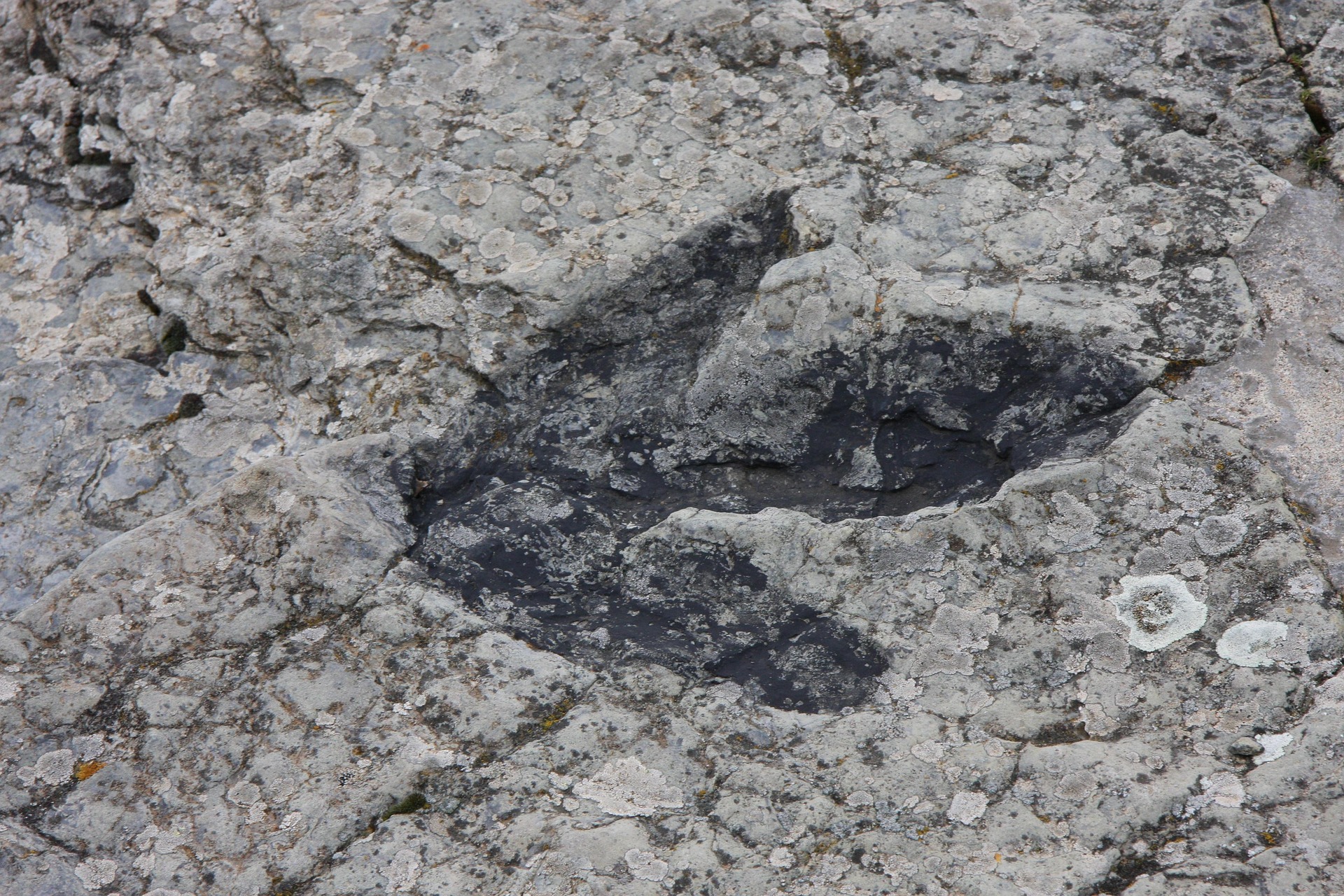
How do we know how old the Earth is? Some clues are hidden in rocks all around us: A spiral shell pressed into stone could be millions of years old!
These fossils are proof that life existed long ago, preserved in layers of rock. Think of it as flipping through Earth's diary. It tells us how ancient the rocks are and the whole story of our planet's past.
Ready to crack open the secrets Earth has been hiding? Let’s go!
What Is the Geological Time Scale
Did you know Earth is 4.6 billion years old? That’s more birthdays than cute cat videos online. To keep track of all that time, play our Geological Time Scale Game to explore Earth’s life story across a single hour!
<Interactive> Geological time scale
.
How Do Scientists Know How Old Earth Is?
<Suggested visual> diagram of geologic principles (source)
Geological Principles
Photo credit: The Field Museum
Geologists read the stories hidden in rock layers by studying stratigraphy. This helps scientists figure out when oceans rolled in, forests sprouted, volcanoes erupted, and deserts swept across the land.
Want to know which rock layer came first? Geologists follow 4 handy rules.
- Superposition
Rocks form in layers over time. The bottom layers are the oldest, and newer layers pile on top.
- Original Horizontality
Most layers start out flat and even. If they’re tilted, folded, or bent, something moved them after they formed, possibly from an earthquake or a mountain pushing them up.
- Lateral Continuity
Rock layers usually stretch out in all directions. If a layer suddenly ends, it was cut off or worn away, but it originally went further.
- Cross-Cutting Relationships
If a crack, fault, or lava flow slices through rock layers, the slice happened after the layers formed. Rocks were there first, then the cut.
What Are Fossils
Fossils are the preserved remains of plants and animals from long ago, buried under layers of mud, sand, or other sediments. Geologists study these fossils to figure out how old the rocks are and what the world was like when they formed. You can think of it as Earth pressing "Save" on a life form from millions of years ago.
While most fossils are found in sedimentary rock, they can sometimes appear in igneous rock or metamorphic rock. For example, footprints were preserved in lava at Pompeii, and marble can hold recognizable remains of sea creatures. These rarer fossils show that traces of life can survive even when rocks are heated, squeezed, or transformed.
Paleontologists deal primarily with two kinds of fossils: body fossils and trace fossils. Body fossils are physical remains of organisms, preserved through the fossilization process. A trace fossil preserves pieces of evidence of life, such as footprints, nests or coprolites, aka fossilized feces!
How Fossils Form
Most creatures slowly vanish after they die. They break down, get eaten, or wash away in the ocean. But once in a while, the right mix of circumstances creates a fossil.
It starts with a fast burial, maybe by a sudden mudslide or volcanic ash. With little oxygen, decay slows down. Then minerals sneak in, soaking through and replacing the hard parts like bones, shells and even pieces of wood.
This slow swap is called mineralization. It’s basically nature’s way of turning a creature into rock-solid history. Bit by bit, the creature becomes stone.
This fossil-making process is called taphonomy (say it like this: ta-FON-uh-mee). Scientists study it to understand how fossils form.
What Is a Fossil Assemblage
When several different fossil species are buried together in the same rock layer, scientists call it a fossil assemblage. It’s like a prehistoric group photo, with every fossil frozen mid-action in the middle of its wild, ancient world.
These fossil clumps show who lived together, what the environment looked like, and how life changed. Scientists use this detective work across rock layers in a method called biostratigraphy. For example, dinoflagellates are tiny plankton that float in oceans and freshwater. Some produce oxygen, and some can multiply so fast they create red tides, turning the water red. Fossilized dinoflagellates are one of many fossils that help scientists track ancient oceans and date rock layers. They are really useful because they are so small and may be better preserved than larger creatures.
Where Can I See Fossils in Canada
Gorgosaurus skeleton, uncovered under layers in Dinosaur Provincial Park, Alberta.
Canada is packed with fossil hotspots. Some are famous, some are hidden gems. Let’s check them out!
Mistaken Point, Newfoundland
Photo credit: Wikipedia
Mistaken Point, Newfoundland: Home to more than 10,000 fossils from bizarre soft-bodied sea creatures (animals without bones or shells). They lived 580 million years ago, way before dinosaurs roamed!
Dinosaur Provincial Park, Alberta
Photo credit: Unesco World Heritage
Dinosaur Provincial Park, Alberta: Step into a real Jurassic adventure! Over 150 dinosaur skeletons unearthed here reveal a world of fierce hunters and gentle giants roaming lush ancient floodplains.
Want to find fossils in Ontario?
Where to Find Fossils in Ontario
Get ready to plan your own fossil-finding field trip!
Crinoids at the Don Valley Brickworks, Toronto
Photo credit: Toronto Wildlife
Don Valley Brickworks, Toronto: Ever imagine digging up a giant beaver tooth bigger than a gaming controller? In the 1800s, geologist Arthur Coleman did just that, discovering Toronto’s ancient wildlife, including a bear-sized beaver (nicknamed The Giant Beaver) and a stag-moose, a creature with moose-like legs and huge deer-like antlers.
Rock Glen Conservation Area, Arkona
Photo credit: Ausable Bayfield Conservation Authority
Rock Glen Conservation Area, Arkona: A super spot to find fossilized sea creatures like brachiopods and horn corals, remains from when Ontario was under a tropical ocean.
Craigleith Provincial Park, Blue Mountains
Photo credit: Wikipedia
Craigleith Provincial Park, Blue Mountains: The shore is lined with smooth, brown upper Ordovician shale that formed about 450 million years ago. This is the oldest rock visible at the surface and a top spot for finding fossils. If you look closely, you might find trilobites, tiny creatures that lived in ancient seas long before dinosaurs!
Grab your boots and curiosity: Your next fossil find could be hiding just beneath your feet.
Statigraphy: The study of rock layers and how they formed over time.
Sedimentary rock: Rock that forms when sand, mud, or tiny pieces of other rocks pile up and harden over time.
Igneous rock: Rock that forms when melted rock (magma or lava) cools and solidifies.
Metamorphic rock: Rock that changes when heat, pressure, or chemicals squeeze or bake it into a new type of rock.
Learn More
Rock cycle